















The AI Gold Rush Isn’t One Race—It’s Several, and Each Industry Is Running Its Own Event
This article provides a deep dive into how differing major industries—from manufacturing to finance—are investing in AI and robotics, each with unique priorities, risks, and go‑to‑market strategies.
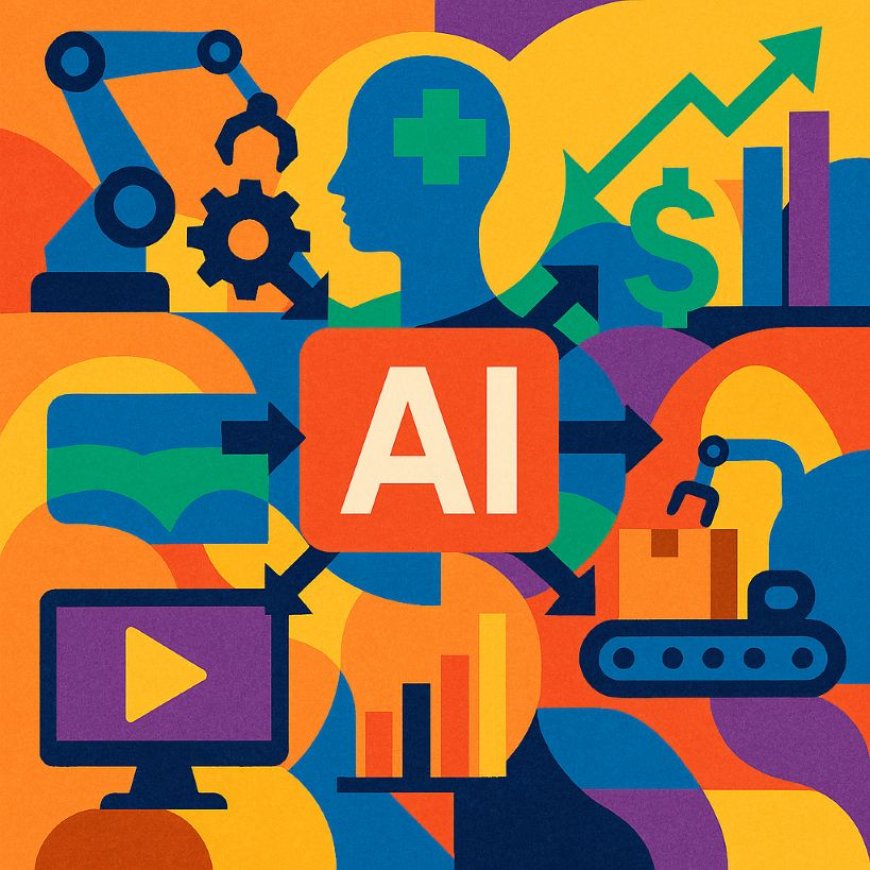
If you listen to the hype cycle, you might think “AI adoption” is a single, monolithic trend sweeping across the economy. In reality, it’s more like a multi‑track tournament: every industry is sprinting toward automation and intelligence, but each is running a different race, with different rules, different stakes, and wildly different definitions of “winning.”
Some sectors are chasing efficiency. Others are chasing entirely new revenue models. A few are chasing survival. And the most interesting part isn’t who’s ahead—it’s how differently they’re choosing to compete.
Let’s break down the industries pouring the most capital and creativity into AI and robotics, and how their go‑to‑market strategies reveal what they value most.
1. Manufacturing & Industrial Automation: The Pragmatists
Primary Goal: Reduce cost, increase throughput, eliminate variability
AI/Robotics Focus: Autonomous production lines, predictive maintenance, quality inspection, digital twins
Go‑to‑Market Strategy: Quiet, incremental, ROI‑driven adoption
Manufacturers aren’t chasing headlines—they’re chasing uptime. Their AI investments are ruthlessly practical: robots that don’t get tired, machine‑vision systems that never blink, and predictive models that prevent million‑dollar shutdowns.
This sector treats AI like a wrench, not a revolution. Vendors selling into manufacturing know the playbook: prove reliability, show a clear payback period, and integrate with legacy systems that were installed when dial‑up internet was still a thing.
Why it works: Manufacturing is allergic to risk. Incrementalism is a feature, not a bug.
2. Healthcare & Life Sciences: The Regulated Innovators
Primary Goal: Improve outcomes, reduce clinician burden, accelerate research
AI/Robotics Focus: Diagnostics, drug discovery, surgical robotics, patient triage, workflow automation
Go‑to‑Market Strategy: Evidence‑heavy, compliance‑first, partnership‑driven
Healthcare wants AI, but it wants it with footnotes, clinical trials, and regulatory sign‑off. This is the only industry where a machine learning model might need a peer‑reviewed paper before it gets deployed.
The innovation is breathtaking—AI‑assisted radiology, robotic surgery, protein‑folding breakthroughs—but the commercialization path is slow and bureaucratic. Vendors must navigate a maze of approvals, hospital procurement committees, and ethical scrutiny.
Why it works: Trust is the currency. Without it, no one touches the product.
3. Finance & Insurance: The Algorithm Addicts
Primary Goal: Risk reduction, fraud detection, hyper‑personalization, speed
AI/Robotics Focus: Algorithmic trading, underwriting automation, fraud analytics, customer service bots
Go‑to‑Market Strategy: Speed‑to‑value, competitive secrecy, aggressive experimentation
Finance has been algorithm‑driven for decades, so AI isn’t a disruption—it’s an upgrade. Banks and insurers deploy AI like a high‑frequency trader deploys capital: fast, quietly, and with a competitive paranoia that borders on obsession.
Their go‑to‑market strategy is simple: move quickly, don’t talk about it, and let the results speak for themselves. The biggest players are building proprietary models and hoarding data like digital gold.
Why it works: In finance, milliseconds matter. AI is a weapon, not a workflow tool.
4. Retail & E‑Commerce: The Customer Whisperers
Primary Goal: Personalization, logistics optimization, margin expansion
AI/Robotics Focus: Recommendation engines, warehouse robotics, dynamic pricing, demand forecasting
Go‑to‑Market Strategy: Customer‑facing innovation, rapid A/B testing, ecosystem integration
Retailers are using AI to understand you better than you understand yourself. From hyper‑personalized product feeds to robotic fulfillment centers, the sector is obsessed with squeezing inefficiencies out of the customer journey.
Their strategy is fast, iterative, and unapologetically experimental. If a model increases conversion by 0.5%, it ships. If it doesn’t, it dies quietly in a data scientist’s Jupyter notebook.
Why it works: Retail rewards speed and punishes hesitation. AI is the new merchandising strategy.
5. Transportation & Logistics: The Autonomy Dreamers
Primary Goal: Reduce labor dependency, improve safety, optimize routing
AI/Robotics Focus: Autonomous vehicles, drone delivery, fleet optimization, robotic loading/unloading
Go‑to‑Market Strategy: High‑risk moonshots paired with incremental operational wins
This industry is split between two extremes:
- Moonshot autonomy companies promising driverless everything
- Practical logistics operators using AI to shave minutes off delivery windows
The moonshot players burn capital like rocket fuel, betting on regulatory breakthroughs and technological leaps. The operators, meanwhile, quietly deploy routing algorithms and warehouse robots that deliver immediate ROI.
Why it works: Logistics is a volume game. Small efficiencies compound into massive savings.
6. Media, Entertainment & Creative Industries: The Identity Crisis
Primary Goal: Content scale, personalization, cost reduction
AI/Robotics Focus: Generative media, automated editing, synthetic actors/voices, recommendation engines
Go‑to‑Market Strategy: Controversy‑prone, audience‑sensitive, innovation‑through‑experimentation
No industry is more conflicted about AI than media. On one hand, AI can generate scripts, edit videos, localize content, and create entire synthetic productions. On the other hand, creators fear displacement, audiences fear inauthenticity, and regulators fear deepfakes.
The go‑to‑market strategy is cautious but opportunistic: experiment behind the scenes, deploy where audiences won’t revolt, and use AI to augment rather than replace.
Why it works: Creativity is emotional. AI must be invisible or delightful—nothing in between.
The Real Story: AI Isn't Transforming Industries the Same Way
What’s striking is not that industries are adopting AI—it’s how differently they’re doing it.
|
Industry |
AI Mindset |
Risk Tolerance |
Speed |
Primary Value Driver |
|
Manufacturing |
Efficiency |
Low |
Slow |
Cost reduction |
|
Healthcare |
Safety & outcomes |
Very Low |
Slow |
Trust & compliance |
|
Finance |
Competitive edge |
Medium |
Fast |
Risk & speed |
|
Retail |
Personalization |
Medium |
Very Fast |
Conversion & logistics |
|
Logistics |
Autonomy & optimization |
Medium-High |
Mixed |
Scale & efficiency |
|
Media |
Creativity & scale |
High (social) |
Fast |
Content volume |
There is no single “AI revolution.” There are dozens of them, each shaped by the incentives, fears, and ambitions of the industries adopting the technology.
The Bottom Line
AI isn’t a universal disruptor—it’s a mirror. Every industry sees in it what it values most:
- Manufacturers see stability.
- Healthcare sees precision.
- Finance sees advantage.
- Retail sees personalization.
- Logistics sees autonomy.
- Media sees scale—and a threat.
The companies that win the next decade won’t be the ones that adopt AI the fastest. They’ll be the ones that adopt it intentionally, aligning technology with the realities of their market, their customers, and their identity.
If the AI gold rush has a lesson, it’s this: the future isn’t automated. It’s differentiated.
Written/published by Kevin Marshall with the help of AI models (AI Quantum Intelligence).
What's Your Reaction?
 Like
0
Like
0
 Dislike
0
Dislike
0
 Love
0
Love
0
 Funny
0
Funny
0
 Angry
0
Angry
0
 Sad
0
Sad
0
 Wow
0
Wow
0