










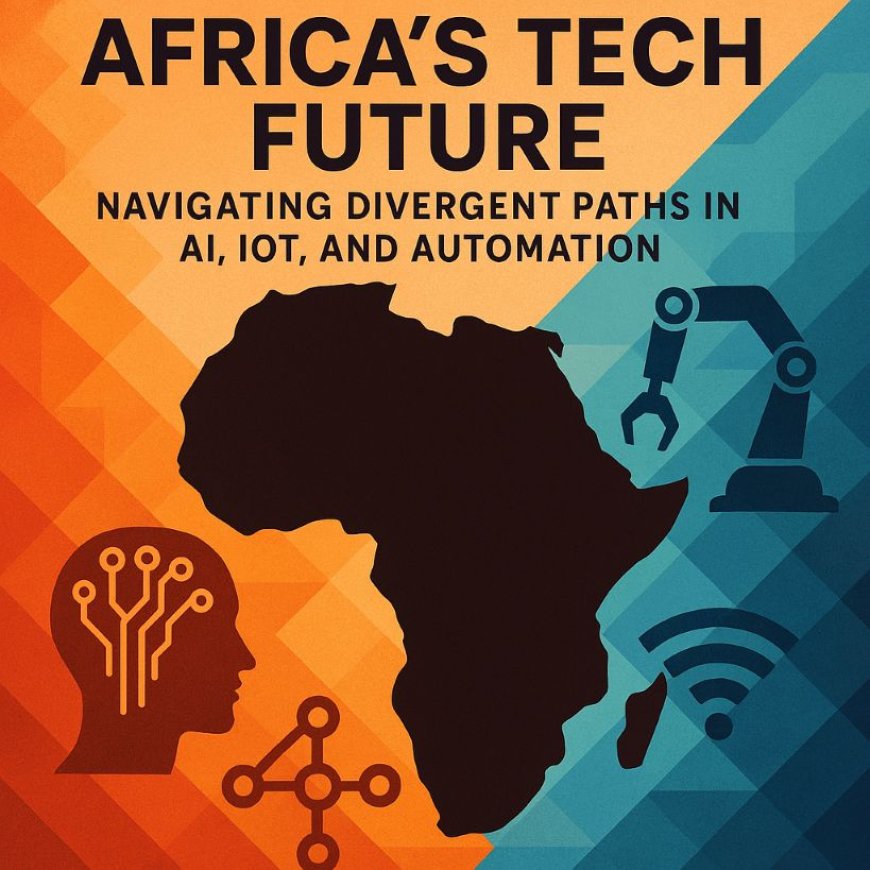
Africa's Tech Future: Navigating Divergent Paths in AI, IoT, and Automation
Explore Africa's unique path in the AI, IoT, and robotics revolution—how the continent leverages demographic dividends, frugal innovation, and mobile-first strategies to build a context-driven tech future. Discover its strengths in leapfrog development, sector-specific AI, and hybrid governance models, alongside critical risks like brain drain, infrastructure gaps, and ethical challenges. Learn why Africa’s approach may redefine inclusive and sustainable technological advancement globally.
Introduction: A Continent at the Digital Crossroads
Africa stands at a pivotal moment in technological history—not as a passive recipient of innovation, but as a potential architect of its own uniquely contextual digital future. Unlike the US-China dichotomy of private sector versus state-led development, Africa faces a more complex landscape shaped by fragmented markets, infrastructural gaps, youthful demographics, and urgent developmental needs. The continent's approach to emerging technologies will likely diverge significantly from existing models, creating what some analysts term "leapfrog development with African characteristics."
Part 1: Divergent Policy Approaches Emerging Across Africa
Africa is not monolithic; three distinct policy clusters are emerging:
1. The Strategic Pragmatists (Rwanda, Kenya, Ghana, Senegal)
These nations are developing coherent national digital strategies with clear priorities:
- Rwanda's "Smart Rwanda Master Plan" emphasizes IoT for agriculture and e-government
- Kenya's "Digital Economy Blueprint" focuses on fintech and digital infrastructure
- Ghana's "Rethinking AI in Africa" framework centers on ethical, inclusive AI
2. The Resource-Led Digitalizers (Nigeria, South Africa, Egypt, Morocco)
Leveraging existing economic weight, these countries pursue:
- Nigeria's focus on AI for resource management and Lagos as a tech hub
- South Africa's established financial and industrial sectors driving enterprise AI
- Egypt's "Digital Egypt" building on existing tech talent and geographic position
3. The Late Starters with Strategic Potential (Ethiopia, DRC, Tanzania)
These nations face infrastructural challenges but offer:
- Ethiopia's greenfield opportunities in telecom and agri-tech
- DRC's mineral resources critical for tech hardware supply chains
Part 2: Investment Priorities – Necessity-Driven Innovation
Africa's investment patterns diverge from both China's state-led and America's venture capital models, favouring:
1. Mobile-First Foundation
- With over 650 million mobile subscribers, solutions build on mobile infrastructure
- M-Pesa's success demonstrates the "mobile leapfrog" potential
2. Sector-Specific Applications Over General AI
- Agri-tech: IoT sensors, drone mapping, and AI-driven yield optimization
- Fintech: Fraud detection, credit scoring, and blockchain-based systems
- Health-tech: Diagnostic AI, telemedicine, and supply chain optimization
- Civic-tech: Digital ID systems, resource management, and service delivery
3. Hybrid Funding Models
- Blended finance combining development funds, impact investment, and corporate partnerships
- Increasing African venture capital (though still just 1% of global VC)
Part 3: Africa's Greatest Strengths – The Competitive Advantages
1. Demographic Dividend
- Youngest population globally (median age 19.7) means rapid adoption and local innovation
- Growing tech talent pool with initiatives like Andela and numerous coding academies
2. Problem-Rich Environment
- Pressing challenges in agriculture, healthcare, education, and infrastructure create immediate application opportunities
- Solutions developed in African contexts often prove adaptable elsewhere
3. Less Legacy Infrastructure
- Ability to adopt newest technologies without entrenched systems resistance
- Potential for decentralized solutions (solar-powered IoT, mesh networks)
4. Regional Collaboration Mechanisms
- African Continental Free Trade Area (AfCFTA) enables scale
- Regional innovation hubs emerging (East Africa's "Silicon Savannah," Nigeria's "Yabacon Valley")
5. Cultural and Linguistic Diversity as AI Asset
- Natural language processing for African languages represents both challenge and opportunity
- Diverse datasets could reduce algorithmic bias
Part 4: Recommended Strategic Areas of Focus
1. Build "AI Public Goods" Infrastructure
- Continent-wide data commons for agriculture, health, and climate
- Open-source AI tools tailored to African languages and contexts
- Shared computing infrastructure to reduce costs
2. Focus on "Augmentation over Automation"
Given employment imperatives, technologies should enhance rather than replace human labour:
- AI-assisted healthcare workers in understaffed systems
- IoT-enhanced smallholder farming
- Robotics for dangerous tasks (mining, waste management)
3. Develop Regulatory Sandboxes
- Adaptive frameworks allowing innovation while protecting rights
- Cross-border harmonization through AU mechanisms
- Focus on data sovereignty and digital public infrastructure
- Avoid over-reliance on any single external partner (US, China, or EU)
- Pursue technology transfer with local capacity building requirements
- South-South collaboration with India, Brazil, and other emerging economies
Part 5: Greatest Risks and Challenges
1. Infrastructure Fragmentation
- Uneven digital access risks creating "tech islands" in a sea of disconnection
- Electricity gaps (600 million Africans lack reliable power) undermine IoT potential
- High data costs relative to income
- Top talent often migrates or concentrates in few hubs
- Limited research funding for AI/ML at African universities
3. External Dependency Risks
- Most cloud infrastructure, hardware, and advanced chips imported
- Risk of digital colonialism through data extraction or imposed standards
4. Governance and Ethical Challenges
- Authoritarian potential of surveillance technologies
- Algorithmic bias imported or amplified in local contexts
- Limited public understanding and debate about AI implications
5. Job Displacement Without Replacement
- Formal employment is already scarce in many economies
- Automation could affect outsourcing sectors (call centers, basic services)
Part 6: The Path Forward – An African Model Emerges
Africa's optimal path likely lies not in replicating either US or Chinese models, but in developing a "frugal innovation ecosystem" characterized by:
1. Contextual Intelligence
- Technologies designed for local conditions (power constraints, language diversity, literacy levels)
- Emphasis on robustness and repairability
2. Community-Centric Design
- Involving end-users in development processes
- Collective ownership models for digital infrastructure
3. Leapfrog with Inclusion
- Prioritizing technologies that bridge rather than widen divides
- Digital public infrastructure as foundation for private innovation
4. Sustainability Integration
- AI/IoT solutions addressing climate adaptation and mitigation
- Circular economic principles in tech deployment
Conclusion: Africa's Distinctive Contribution
The most promising African technological future is one that embraces its differences rather than seeking to mimic others. The continent's strength lies in solving real-world problems under constraints, developing frugal innovations, and leveraging its youth dividend.
The greatest opportunity may be in developing "appropriate AI"—systems designed for specific African contexts that prove globally relevant for similar environments elsewhere. Rather than trying to win the AI race as defined by existing powers, Africa might redefine the race itself—prioritizing technologies that enhance human dignity, community resilience, and sustainable development.
The risk is that external forces and internal inequalities could divert this potential toward extractive or divisive ends. But with strategic vision, collaborative governance, and investment in digital public goods, Africa could model how emerging technologies serve human development in resource-constrained, diverse, and dynamic environments—a lesson the entire world increasingly needs to learn.
Written/published by Kevin Marshall with help from AI models (AI Quantum Intelligence).
What's Your Reaction?
 Like
0
Like
0
 Dislike
0
Dislike
0
 Love
0
Love
0
 Funny
0
Funny
0
 Angry
0
Angry
0
 Sad
0
Sad
0
 Wow
0
Wow
0