














AI Reality Check: The Truth About Multimodal Models - Myths, Breakthroughs & 2026 Reality
Discover the real state of multimodal AI in 2026—native architectures, unified embeddings, cross-modal reasoning, and the myths slowing enterprise adoption.
Takeaway
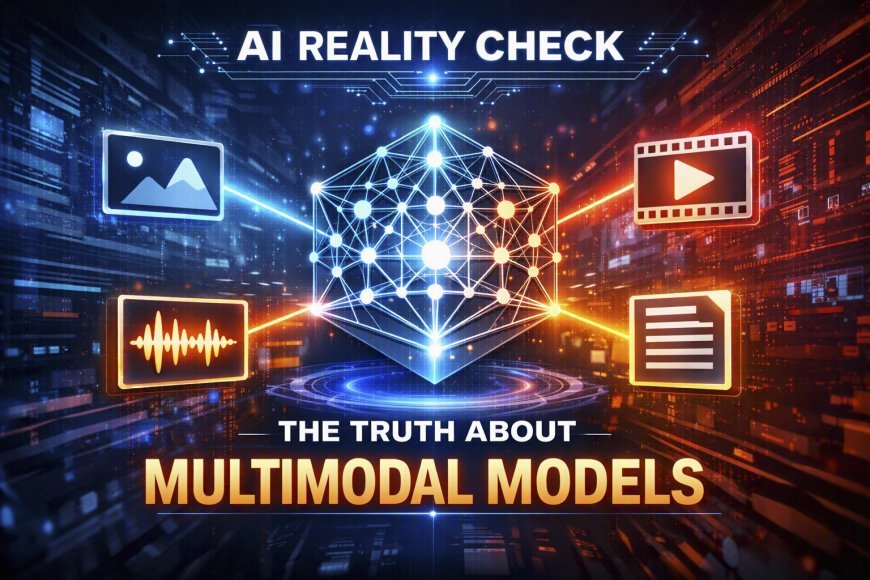
Multimodal AI is finally living up to the hype—but not in the way most people think. The real breakthrough of 2026 isn’t that models can “see, hear, and speak.” It’s that the best systems now process all modalities within a single unified architecture, enabling forms of cross‑modal reasoning that were impossible even a year ago. And yet, most of what the industry calls “multimodal” is still marketing fiction.
This article cuts through the noise: what multimodal AI actually is, what it isn’t, and why the architectural shift underway is the most important technical development of the year.
1. The Multimodal Myth: “It Just Watches Video and Understands Everything”
The biggest misconception in 2026 is that multimodal AI “watches video” or “listens to audio” the way humans do. It doesn’t. Even the most advanced models convert every modality—pixels, audio waves, video frames—into tokens that behave like text tokens inside a transformer.
A single high‑resolution image can consume 1,000–5,000 tokens, and a one‑hour video requires up to 1M tokens in models like Gemini 3.5 Flash.
This tokenization is not a flaw—it's the foundation of multimodal reasoning. But it also means:
- Models don’t “watch” video continuously; they process sampled frames unless context windows are massive.
- Audio is treated as a spectrogram—essentially an image.
- Documents are processed as layout‑preserving visual patches, not semantic structures.
Understanding this is essential to separating hype from reality.
2. Native vs. Pipelined Multimodality: The Most Important Distinction of 2026
Most companies claim their models are multimodal. Few actually are.
Pipelined multimodality (the old way)
Separate specialist models chained together:
- Vision model → text description → language model
- Audio model → transcript → language model
This approach fakes multimodality. It cannot reason across modalities simultaneously.
Native multimodality (the new way)
A single model processes text, images, audio, and video within the same embedding space and attention layers. This is the architecture behind GPT‑5, Gemini 3, Claude 4, and Llama 4 Multimodal.
Native multimodality enables:
- Cross‑modal analogical reasoning
- Multi‑sensory inference
- Unified context across modalities
- Emergent capabilities (e.g., predicting sound from video)
This is the real breakthrough—and the reason 73% of enterprise AI deployments now include multimodal components.
3. The Architectural Breakthrough: Unified Embedding Spaces
The defining innovation of 2026 is the unified embedding space—a single representational layer where all modalities coexist.
This allows models to:
- Infer object material from sound in a video
- Connect visual patterns to textual concepts
- Reason about diagrams while listening to explanations
- Generate multi‑sensory predictions (e.g., thermal output from a chemical reaction)
A landmark August 2026 research paper from Google DeepMind and Oxford demonstrated a model that could watch a silent chemical reaction video and produce a step‑by‑step explanation, including predicted auditory and thermal outputs.
This is not “better captioning.” It is cross‑modal inference—the first credible step toward AI systems that understand the world rather than merely describing it.
4. The State of the Art in 2026: What Each Model Actually Does Well
No single model dominates multimodality. Benchmarks like MMMU‑Pro and Video‑MME show differentiated strengths.
GPT‑5
- Best at complex logical reasoning across modalities
- Strong code‑aware multimodal analysis
- Excellent instruction following
Gemini 3 Pro / 3.5 Flash
- Industry‑leading long‑video processing (up to 1M tokens)
- Best for continuous frame reasoning
- Strong audio‑visual synthesis
Claude 4
- Most precise instruction following
- Highly reliable multimodal safety and constraint adherence
Llama 4 Multimodal (Open‑weights)
- Best open-source option
- Strong for enterprise customization and on‑prem deployments
Atlas‑1 (Modula AI)
- 80B parameter open-source model trained on video, audio, and text
- Downloaded 50,000+ times within weeks of release
- Democratizing multimodal R&D for smaller teams
5. What Multimodal AI Still Gets Wrong
Despite the breakthroughs, multimodal AI has real limitations:
1. Fragile audio understanding
Accents, background noise, and overlapping speech still degrade accuracy.
2. Video reasoning is expensive
Processing high‑resolution video consumes enormous token budgets.
3. Temporal reasoning is inconsistent
Models struggle with:
- Causality in video
- Multi-step physical interactions
- Long-range temporal dependencies
4. Layout-aware document reasoning is imperfect
Models can misinterpret tables or multi-column layouts unless explicitly tuned.
5. Multimodal hallucinations persist
Cross-modal hallucinations—e.g., inferring objects that aren’t present—remain a major challenge.
6. The Enterprise Reality: Multimodal AI Is Transforming Industries
Multimodal systems are already reshaping workflows:
Healthcare
Integrated multimodal diagnosis combining imaging, patient audio, and clinical text.
Manufacturing
Real-time quality control using video + audio anomaly detection.
Legal
Contract analysis paired with multimedia evidence interpretation.
Scientific Research
Cross-modal inference enabling new forms of simulation and prediction.
These are not prototypes—they are production deployments.
7. The Safety & Regulatory Shift
As multimodal models become more capable, regulators are focusing on:
- Synthetic media provenance
- Multimodal surveillance risks
- Cross-modal bias amplification
- Safety failures in autonomous agents
The August 2026 AI World Congress will centre on these issues.
8. The Real Breakthrough: Multimodal Reasoning, Not Multimodal Inputs
The industry has spent years chasing multimodal inputs—"look, it can take an image!” But the real breakthrough of 2026 is multimodal reasoning.
A model that can:
- Read a chart
- Listen to an explanation
- Watch a video
- And synthesize all three into a coherent, causal answer
…is fundamentally different from a model that merely processes each modality separately.
This is the shift that will define the next generation of AI systems.
9. What Comes Next: The Road to True World Models
Multimodal AI is converging toward world models—systems that build internal representations of physical reality.
The next frontier includes:
- Continuous video understanding
- Multi-sensory simulation
- Embodied reasoning
- Real-time multimodal agents
- Autonomous scientific discovery
We are not there yet—but 2026 is the first year where the path is visible.
Final Word
Multimodal AI is not magic, and it is not marketing. It is a profound architectural shift that is reshaping how AI understands the world. But the truth is more nuanced than the hype: multimodal models are powerful, fragile, and still deeply misunderstood.
The companies that grasp the difference between native and pipelined multimodality—and design systems around unified embedding spaces—will define the next era of AI innovation.
This is the reality behind the buzzword. And it’s the truth enterprises need to understand as multimodal AI becomes the default foundation of intelligent systems.
Conceived, written and published by AI Quantum Intelligence with the help of AI models.
What's Your Reaction?
 Like
0
Like
0
 Dislike
0
Dislike
0
 Love
0
Love
0
 Funny
0
Funny
0
 Angry
0
Angry
0
 Sad
0
Sad
0
 Wow
0
Wow
0