



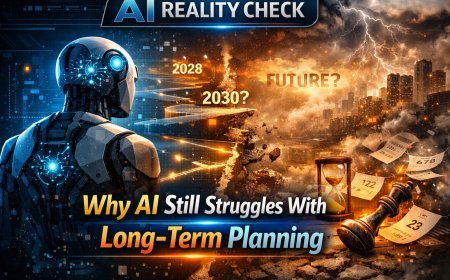








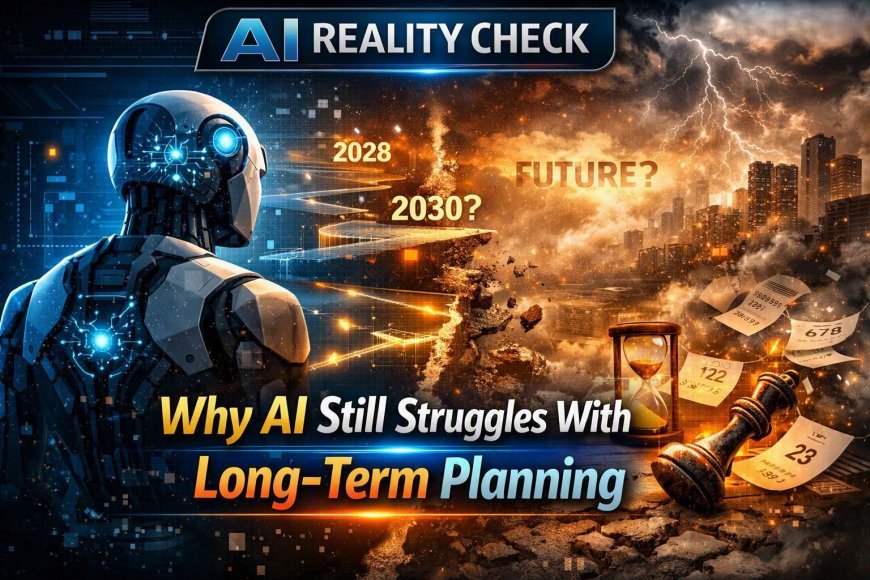
AI Reality Check: Why AI Still Struggles With Long‑Term Planning
AI systems excel at short‑term prediction but falter when asked to plan far ahead. This article explores the technical and conceptual reasons behind AI’s struggle with long‑term planning—from temporal discounting and static goals to missing causal models—and highlights emerging breakthroughs in temporal intelligence, memory architectures, and hybrid human‑AI strategy design.
Takeaway
Despite amazing progress in reasoning, language, and pattern recognition, AI still falters when asked to plan far ahead. From supply‑chain optimization to autonomous strategy, today’s systems excel at short‑term prediction but stumble with sustained foresight. This article explores why long‑term planning remains one of AI’s hardest frontiers—and what breakthroughs are beginning to reshape that horizon.
The Myth: AI as a Master Strategist
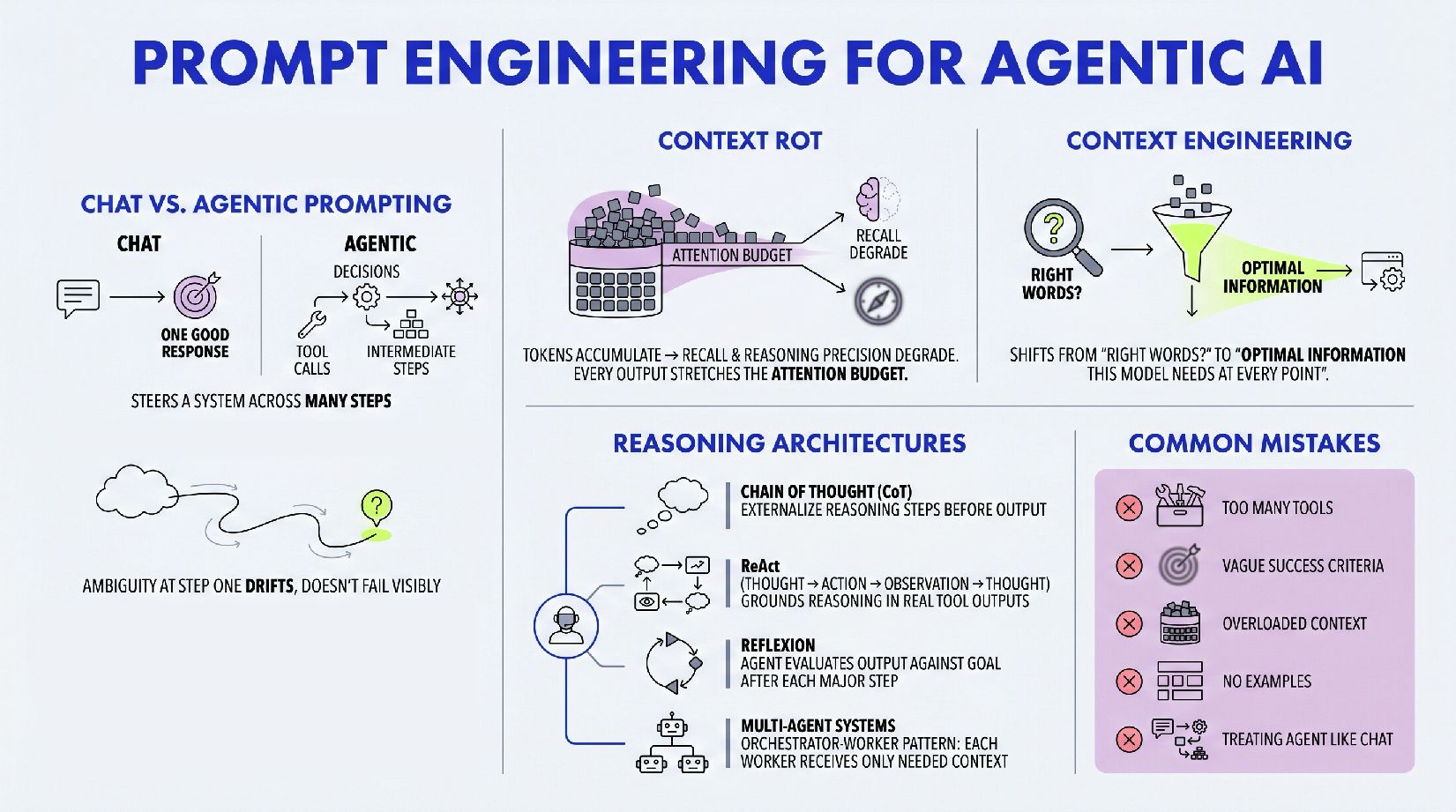
Popular narratives often portray AI as a flawless planner—capable of orchestrating complex operations, predicting outcomes years in advance, and optimizing every decision along the way. In reality, most AI systems are reactive, not strategic. They respond to immediate data, optimize short‑term objectives, and lack the structural memory or causal reasoning needed for durable plans.
The myth persists because short‑term success looks deceptively like strategy. When a model predicts tomorrow’s demand or next week’s traffic, it feels intelligent. But true planning requires temporal abstraction—the ability to reason across time, uncertainty, and changing goals.
Why Long‑Term Planning Is Hard for AI
1. The Horizon Problem
AI models are trained on finite sequences. Whether in reinforcement learning or predictive modelling, the system’s “view” of the future is limited by its training horizon. When rewards or outcomes occur far downstream, the signal fades. This leads to temporal discounting—the tendency to prioritize immediate gains over distant ones. Humans intuitively bridge this gap through imagination and narrative; machines do not.
2. The Fragility of Goals
Real‑world goals evolve. A company’s priorities shift, markets fluctuate, and constraints change. Most AI systems assume static objectives—once trained, they pursue the same reward function indefinitely. When the environment changes, the plan collapses. Long‑term planning demands adaptive goal management, something current architectures rarely support.
3. The Missing Model of the World
To plan effectively, an agent must understand how the world works—how actions ripple through time. Large language models and deep networks learn correlations, not causality. Without a causal model, they can’t simulate consequences beyond immediate feedback. This is why AI often fails at multi‑step reasoning in open environments: it lacks a coherent internal map of cause and effect.
4. Computational Explosion
Planning across long horizons requires exploring exponentially more possibilities. Even with modern GPUs and distributed systems, the combinatorial space of future states grows faster than computation can handle. Humans simplify through intuition and heuristics; AI must brute force or approximate. The result: strategic blindness beyond a few steps.
5. Memory and Continuity
Most AI systems have short‑term memory. They can recall context within a conversation or simulation but struggle to maintain continuity across months or years. Long‑term planning requires persistent memory—tracking commitments, dependencies, and evolving conditions. Without it, AI becomes a brilliant tactician but a poor strategist.
Why the Myth Persists
AI’s short‑term brilliance creates the illusion of foresight. When a model predicts stock trends or optimizes logistics, it looks strategic. But these are local optimizations, not global plans. The myth endures because success in narrow domains feels like general intelligence.
Media narratives amplify this confusion, equating predictive accuracy with strategic depth. In truth, prediction ≠ planning. Prediction answers “what might happen next.” Planning answers "What should we do now to shape what happens later?"
The Breakthroughs: Toward Temporal Intelligence
Recent research is beginning to chip away at these limits:
- Hierarchical Reinforcement Learning: breaks complex tasks into sub‑goals, enabling multi‑level planning.
- World Models: agents learn internal simulations of their environment to reason about future states.
- Memory‑augmented architectures: integrate long‑term context retention.
- Causal reasoning frameworks: allow models to infer how actions propagate through time.
- Hybrid human‑AI planning systems: combine machine precision with human foresight.
These innovations mark the emergence of temporal intelligence—AI that doesn’t just react but anticipates.
The Real‑World Implications
Long‑term planning failures manifest everywhere:
- Autonomous vehicles misjudge rare future events.
- Supply‑chain optimizers fail under unexpected disruptions.
- Conversational agents lose coherence across extended dialogues.
- Strategic AI in business or defense overfits to short‑term metrics.
Understanding these limits isn’t pessimism—it’s realism. It’s how we design systems that complement human foresight rather than replace it.
The Future: Designing for Time
The next generation of AI will treat time as a first‑class dimension, not a side effect. That means:
- Embedding temporal reasoning into architectures.
- Building persistent memory systems that evolve with experience.
- Integrating human strategic oversight to guide adaptive goals.
- Developing ethical frameworks for long‑term impact assessment.
When AI learns to think in decades, not milliseconds, it will finally begin to plan like us—and perhaps beyond us.
Closing Thought
AI’s struggle with long‑term planning isn’t a flaw—it’s a frontier. The challenge isn’t teaching machines to predict the future; it’s teaching them to care about it. Only then will intelligence become truly strategic.
Conceived, written, and published by AI Quantum Intelligence with the help of AI models.
What's Your Reaction?
 Like
0
Like
0
 Dislike
0
Dislike
0
 Love
0
Love
0
 Funny
0
Funny
0
 Angry
0
Angry
0
 Sad
0
Sad
0
 Wow
0
Wow
0