








AI Reality Check: Why AI Hallucinations are a Feature, Not a Bug
AI hallucinations aren't simply errors. Discover why hallucinations are an unavoidable part of generative AI, how they drive creativity and innovation, and why managing them matters more than eliminating them.
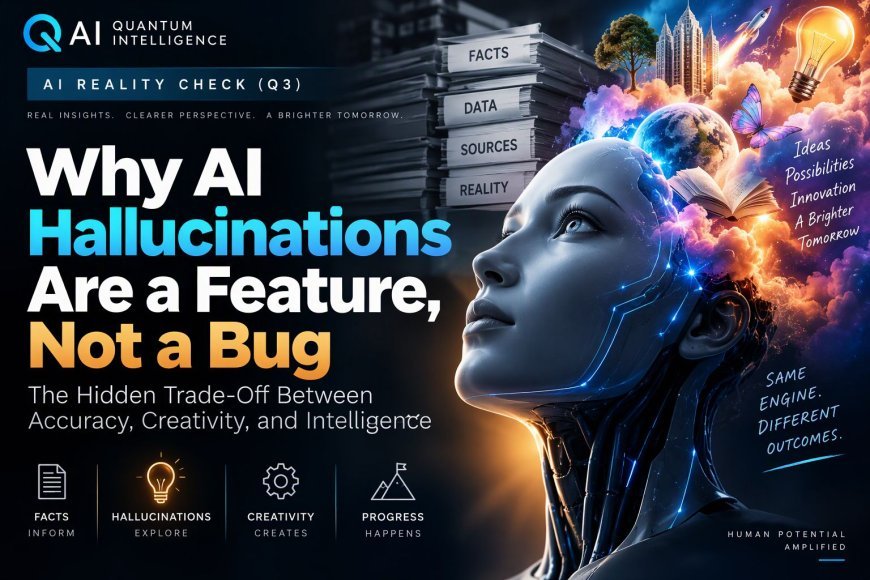
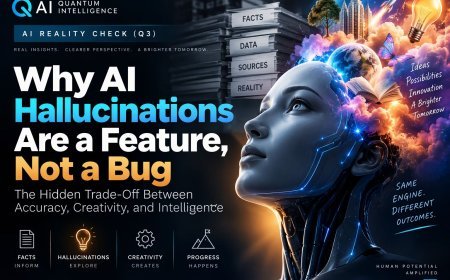
Why AI Hallucinations Are a Feature, Not a Bug
By AI Quantum Intelligence
The AI Problem Everyone Talks About
Ask almost anyone about the risks of artificial intelligence, and sooner or later the conversation turns to hallucinations.
An AI chatbot invents a court case that never existed. A virtual assistant confidently cites a fictional research paper. A content-generation tool produces statistics that sound impressive but have no basis in reality.
The reaction is usually the same: AI is broken.
But what if that's the wrong conclusion?
What if hallucinations are not a software defect accidentally left in the system but rather an unavoidable byproduct of the very capability that makes modern AI valuable?
The reality is more uncomfortable and far more interesting.
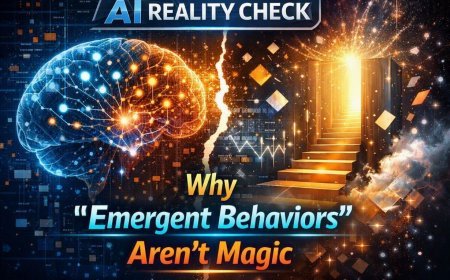
AI hallucinations are not simply bugs that engineers forgot to fix. They are a natural consequence of how generative AI creates language, ideas, images, code, and knowledge. In fact, the same mechanism that produces hallucinations is also responsible for creativity, innovation, problem-solving, and discovery.
The challenge is not eliminating hallucinations entirely.
The challenge is learning when they are dangerous, when they are useful, and how to distinguish between the two.
First, What Is an AI Hallucination?
In simple terms, an AI hallucination occurs when a model generates information that appears plausible but is incorrect, fabricated, or unsupported by evidence.
The important word is plausible.
Generative AI systems are not databases retrieving facts one by one. They are prediction engines. Their primary task is to determine what content is most likely to come next based on patterns learned from enormous datasets.
As a result, they can produce responses that sound authoritative even when the underlying information is inaccurate.
That behavior understandably worries organizations deploying AI into healthcare, law, finance, education, government, and other high-trust environments.
Yet labeling hallucinations as merely "errors" overlooks a deeper truth about intelligence itself.
The Human Brain Hallucinates Too
One reason AI hallucinations generate so much attention is that people often compare AI to computers of the past.
Traditional software followed rigid rules.
If you entered 2 + 2, the answer was always 4.
If you searched a database, it returned data that existed in the database.
Generative AI is fundamentally different.
It resembles aspects of human cognition more than conventional computing.
Humans constantly generate incomplete predictions, assumptions, narratives, and mental models.
We fill in gaps.
We infer.
We imagine.
We create explanations from limited information.
Psychologists have long documented that human memory itself is reconstructive rather than perfectly reproductive. People often remember events incorrectly while remaining convinced their recollections are accurate.
In other words, humans hallucinate all the time.
We simply use different words:
- Assumptions
- Guesses
- Intuition
- Speculation
- Creativity
- Imagination
- Memory distortion
The difference is that when a human does it, we often regard it as part of normal cognition.
When AI does it, we call it a hallucination.
Creativity and Hallucination Share the Same Engine
This is where the discussion becomes truly interesting.
Imagine an AI system that never hallucinates.
Absolutely never.
Such a system would only repeat previously verified information.
It would never extrapolate.
Never infer.
Never imagine possibilities.
Never propose novel connections.
Never generate original concepts.
In short, it would behave more like a search engine than a creative collaborator.
The capabilities that people find most useful in generative AI depend on the ability to synthesize information in new ways.
When AI:
- Creates a marketing campaign
- Designs a logo concept
- Suggests a scientific hypothesis
- Writes a story
- Generates software code
- Produces strategic recommendations
It is moving beyond simple retrieval.
It is generating possibilities.
Every possibility begins as a prediction.
And every prediction carries the risk of being wrong.
The same mechanism that creates innovation also creates hallucination.
You cannot maximize one while completely eliminating the other.
Why Perfect Accuracy Is Probably Impossible
Many people assume future AI systems will eventually become 100% accurate.
The reality may be more complicated.
Generative models operate in environments filled with uncertainty.
Questions are often ambiguous.
Information may be incomplete.
Expert opinions may conflict.
Knowledge changes over time.
Even humans disagree about what constitutes truth in many domains.
As AI systems tackle increasingly complex problems, they must generate probabilistic answers rather than mechanically retrieve static facts.
That means uncertainty is not a temporary flaw waiting to be engineered away.
It is part of the operating environment.
The goal is not perfection.
The goal is calibrated confidence, transparency, and validation.
The Real Danger Is False Confidence
Hallucinations themselves are not the greatest risk.
The greater risk is when users mistake generated content for verified truth.
Historically, people have learned to evaluate information sources differently.
We understand that:
- Advertisements require skepticism.
- Social media posts require verification.
- Rumors require confirmation.
- Opinion pieces are not scientific studies.
AI requires a similar level of literacy.
Users must learn an essential distinction: Fluent language is not evidence.
An AI response may sound intelligent, detailed, confident, and professional.
None of those characteristics guarantee correctness.
Organizations that successfully adopt AI are discovering that verification processes matter more than perfect model accuracy.
Trust should be earned through validation, not assumed through eloquence.
When Hallucinations Become Valuable
The word "hallucination" carries a negative connotation, but there are situations where AI-generated speculation can be highly valuable.
Consider innovation sessions.
- A product-design team may ask an AI for unconventional feature ideas.
- A scientist may explore alternative explanations for an observation.
- A writer may seek unexpected story directions.
- A strategist may investigate disruptive market scenarios.
In these cases, factual certainty is not the primary objective.
Novel thinking is.
Many breakthrough discoveries begin as ideas that initially seem improbable.
The value lies not in immediate correctness but in expanding the range of possibilities being considered.
Viewed from this angle, certain hallucinations resemble brainstorming.
Not facts.
Possibilities.
And possibilities often precede innovation.
The Enterprise Perspective
Business leaders frequently ask a reasonable question:
"If hallucinations are a feature, how can we trust AI?"
The answer is that trust should be built at the system level rather than the model level.
Organizations should combine:
- Retrieval systems
- Trusted knowledge bases
- Human review
- Governance controls
- Explainability mechanisms
- Audit processes
Well-designed AI deployments do not depend on blind trust in model outputs.
They create workflows where verification is built into the process.
The future of enterprise AI is unlikely to be a world without hallucinations.
It is more likely to be a world where hallucinations are actively managed, detected, and contextualized.
Just as cybersecurity assumes threats will exist, AI governance assumes uncertainty will exist.
The objective is resilience, not perfection.
A More Honest Definition of Intelligence
Perhaps the most revealing lesson is philosophical.
For decades, many people imagined intelligence as the ability to produce correct answers.
Generative AI is forcing us to reconsider that assumption.
Intelligence may be better understood as the ability to generate possibilities, evaluate alternatives, adapt to uncertainty, and create solutions under imperfect conditions.
Seen through that lens, hallucinations are not evidence that AI lacks intelligence.
They may be evidence that AI is exhibiting one of intelligence's most fundamental characteristics:
The ability to go beyond what is known.
Of course, that ability introduces risk. But it also creates opportunity.
The same cognitive leap that invents a false citation can also invent a groundbreaking idea.
The mechanism is remarkably similar.
The outcome depends on context, validation, and judgment.
Reality Check
The next time someone claims AI hallucinations prove that artificial intelligence is failing, consider a different perspective.
Hallucinations reveal that modern AI is not simply retrieving information.
It is generating possibilities.
That capability is exactly what makes AI powerful.
The challenge for organizations, professionals, and society is not to expect AI to become incapable of hallucinating.
The challenge is learning when to trust AI, when to verify it, and when to leverage its imaginative capacity to explore ideas humans might otherwise miss.
Because the future of AI will not belong to those who eliminate uncertainty.
It will belong to those who learn how to work with it.
AI Reality Check: Hallucinations are not proof that AI is broken. They are evidence that generative AI operates in the space between what is known and what might be possible. The real competitive advantage lies not in removing that capability but in governing it wisely.
What's Your Reaction?
 Like
0
 Dislike
0
 Love
0
 Funny
0
 Angry
0
 Sad
0
 Wow
0