



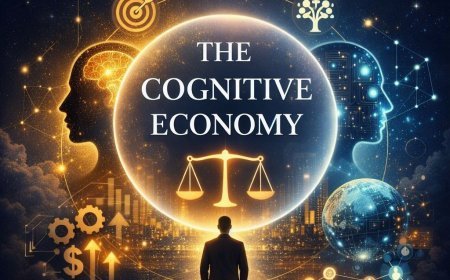







The Intelligence Shift: The Cognitive Economy - Competing in a World of Infinite Intelligence
In the cognitive economy, intelligence becomes abundant, and markets reorganize around direction, judgment, and values. This article explores how competitive advantage shifts when AI transforms cognition into infrastructure—reshaping strategy, governance, productivity, and the future of human roles. Learn how organizations can thrive in a world of infinite intelligence by mastering orchestration, identity driven moats, and adaptive decision systems.
The Takeaway
When intelligence becomes abundant, markets stop rewarding knowledge and start rewarding direction. The scarce resource is no longer the ability to think but the ability to choose—to aim intelligence toward outcomes that matter. The cognitive economy is the first economic system in history where intelligence is not a human trait, not a corporate asset, but a ubiquitous substrate. And everything built on top of it begins to reorganize.
I. The End of the Knowledge Advantage
For centuries, economies rewarded those who could accumulate knowledge faster than others: scholars, analysts, engineers, strategists, and institutions. Knowledge was capital. Expertise was leverage. Intelligence was a differentiator.
But in a world where:
- reasoning is on‑demand
- analysis is instantaneous
- creativity is infinitely generative
- and every actor has access to the same cognitive infrastructure
the traditional knowledge advantage collapses.
This is the first time in human history where intelligence is no longer a competitive moat. It is a commodity—abundant, cheap, and universally accessible.
The winners of the cognitive economy are not the smartest. They are the most intentional.
II. When Intelligence Becomes Infrastructure
AI is no longer a tool; it is a substrate. A layer beneath every industry, every workflow, every market. Intelligence becomes something you plug into, not something you cultivate.
This shift mirrors the rise of electricity in the industrial era:
- Electricity didn’t make factories smarter.
- It made factories faster, scalable, and continuous.
AI does the same for cognition.
It turns thinking into a utility.
And once cognition becomes a utility, markets reorganize around those who can deploy it most effectively—not those who possess it.
III. The New Scarcity: Direction, Judgment, and Values
If intelligence is infinite, what becomes scarce?
Three things:
1. Direction
Infinite intelligence still needs a target. The ability to define what matters becomes the new strategic advantage.
2. Judgment
AI can generate possibilities, but humans still choose among them. Judgment becomes the premium skill—the ability to select the right path from infinite options.
3. Values
When intelligence can optimize anything, values determine what gets optimized. Ethics, purpose, and mission become economic drivers, not philosophical luxuries.
In the cognitive economy, values are the new algorithms.
IV. Markets Shift from Production to Orchestration
Traditional markets reward production: making things, delivering services, and generating output.
Cognitive markets reward orchestration:
- coordinating intelligence
- aligning agents
- directing cognitive resources
- shaping emergent behavior
- designing systems that think on your behalf
The most valuable companies will not be those that produce the most intelligence, but those that orchestrate the most intelligence toward coherent outcomes.
This is the rise of meta‑productivity—productivity built on top of intelligence itself.
V. The Collapse of Traditional Competitive Moats
When intelligence is abundant, many moats evaporate:
- Expertise moats → replaced by AI‑augmented reasoning
- Scale moats → replaced by autonomous agents
- Data moats → weakened by synthetic data and universal models
- Brand moats → challenged by infinite content generation
- Labour moats → disrupted by cognitive automation
The only moats that survive are those tied to identity:
- trust
- mission
- community
- narrative
- governance
- proprietary values
In the cognitive economy, identity becomes strategy.
VI. The Rise of Cognitive Capital
Cognitive capital is the ability to deploy intelligence at scale with minimal friction. It includes:
- agent networks
- autonomous workflows
- cognitive supply chains
- intelligence routing systems
- decision‑layer architectures
- human‑AI governance frameworks
Companies with high cognitive capital can:
- make decisions faster
- adapt markets in real time
- personalize at population scale
- simulate futures before acting
- compress innovation cycles from years to days
Cognitive capital becomes the new measure of economic power.
VII. Competition Becomes a Race of Adaptation
In the cognitive economy, competition is not about who has the best product—it's about who can adapt fastest.
Markets become fluid. Strategies become dynamic. Organizations become living systems.
The competitive cycle compresses:
- Idea → Prototype → Market happens in hours
- Feedback → Iteration → Relaunch happens in minutes
- Strategy → Execution → Optimization happens continuously
The companies that thrive will be those that treat intelligence as a flow, not a resource.
VIII. Human Roles Shift from Doing to Deciding
As intelligence becomes abundant, human roles evolve:
From operators → to orchestrators
Humans stop performing tasks and start directing cognitive systems.
From analysts → to adjudicators
Humans stop interpreting data and start validating AI‑generated insights.
From creators → to curators
Humans stop producing content and start shaping meaning.
From workers → to governors
Humans stop executing workflows and start defining the rules intelligence must follow.
The cognitive economy elevates humans from labour to leadership—not because humans are smarter, but because humans decide why intelligence is used.
IX. Governance Becomes the New Competitive Frontier
When intelligence is infinite, governance determines outcomes.
The companies that win will be those that master:
- AI alignment
- cognitive risk management
- agent oversight
- ethical optimization
- value‑driven decision frameworks
- transparent intelligence routing
Governance becomes a product. Governance becomes a brand. Governance becomes a competitive advantage.
In the cognitive economy, the most trusted systems win.
X. The Future: Competing in a World of Infinite Intelligence
The cognitive economy is not a future scenario — it is the emerging reality of 2026 and beyond.
Its defining truth is simple:
When intelligence is everywhere, the only scarcity is intention.
The organizations that thrive will be those that:
- aim intelligence toward meaningful outcomes
- build identity‑driven moats
- orchestrate cognitive systems with precision
- govern intelligence with transparency
- adapt faster than the markets they operate in
The cognitive economy rewards those who understand that intelligence is no longer the game—it is the field on which the game is played.
And in this new world, the winners are not the ones who think the most, but the ones who decide the best.
Let us know in the comments if you are experiencing this role transformation in your workplace or industry.
Written and published by AI Quantum Intelligence with the help of AI models.
What's Your Reaction?
 Like
0
Like
0
 Dislike
0
Dislike
0
 Love
0
Love
0
 Funny
0
Funny
0
 Angry
0
Angry
0
 Sad
0
Sad
0
 Wow
0
Wow
0