











The Algorithmic Arms Race: Navigating the Paradox of AI in Cybersecurity
Explore the paradox of AI in cybersecurity. From polymorphic malware to autonomous agents, learn how to defend against weaponized efficiency in the era of AI vs. AI. We have entered the Algorithmic Arms Race. This article looks at how Generative AI, IoT vulnerabilities, and autonomous agents are reshaping the threat landscape, moving the industry from static defense to behavioral resilience.
In the modern Security Operations Center (SOC), we are witnessing a fundamental shift in the physics of cyber warfare. For decades, the asymmetry of cybersecurity favored the attacker: a defender had to be right 100% of the time, while an attacker only needed to be right once.
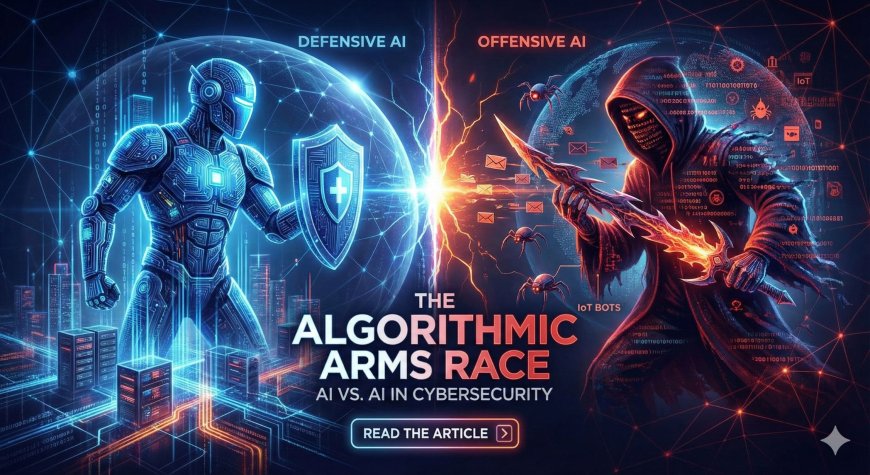
Artificial Intelligence (AI) and Machine Learning (ML) were promised as the great equalizers—tools that would grant defenders the speed and scale to close this gap. Yet, as we integrate these technologies, we face a stark paradox: the very algorithms designed to fortify our digital estates are being weaponized to dismantle them. We have entered the era of AI vs. AI, a high-stakes algorithmic arms race where the speed of engagement is measured in milliseconds, and the battlefield is expanding into autonomous agents and the Internet of Things (IoT).
This is no longer just about patching vulnerabilities; it is about surviving the "democratization of sophistication."
The Offensive Pivot: Weaponized Efficiency
The most immediate threat AI poses is not necessarily new attacks, but the hyper-efficiency of existing ones. Generative AI and LLMs (Large Language Models) have lowered the barrier to entry for cybercrime, allowing "script kiddies" to execute campaigns previously reserved for state-sponsored actors.
1. The Death of Static Signatures
Traditional malware is static; once identified, a signature is created, and the threat is neutralized. AI changes this calculus through Polymorphic Malware.
Case Study: BlackMamba
Researchers have demonstrated proof-of-concepts like "BlackMamba," a malware that uses generative AI to synthesize code at runtime. It reaches out to an LLM API, generates a unique malicious payload, executes it in memory, and then discards it. There is no file to scan, and the "signature" changes every time it executes.
2. Social Engineering 2.0
The days of spotting phishing emails by looking for typos and poor grammar are over.
- Context-Aware Phishing: Attackers use AI to scrape public data (LinkedIn, X, corporate bios) to generate hyper-personalized, contextually accurate spear-phishing emails that are indistinguishable from legitimate correspondence.
- Deepfakes & Vishing: Voice cloning technology now allows attackers to impersonate C-suite executives in real-time phone calls (vishing), authorizing fraudulent transfers with terrifying success rates.
3. Automated Vulnerability Discovery
AI agents can now scan attack surfaces 24/7, probing for weaknesses in code or configurations much faster than human red teams. They don't sleep, they don't eat, and they can parallel-process thousands of vectors simultaneously.
The Defensive Shield: Fighting Fire with Fire
If the offense is moving at machine speed, the defense cannot move at human speed. The traditional OODA loop (Observe, Orient, Decide, Act) is too slow.
1. Behavioral Analytics over Signatures
Since we can no longer rely on file hashes (thanks to polymorphism), defense must pivot to Behavioral Analysis. AI models now baseline "normal" user and network behavior.
- Example: If a user in accounting suddenly accesses a developer database at 3:00 AM and initiates a high-volume data transfer, the AI flags the behavior, regardless of the credentials used.
2. Automated Response (SOAR)
Security Orchestration, Automation, and Response (SOAR) platforms are evolving into autonomous defense systems. When a threat is detected, the AI doesn't just alert an analyst; it isolates the endpoint, revokes the token, and updates the firewall rules instantly.
3. Predictive Intelligence
Advanced ML models are moving from detection to prediction. By analyzing global threat feeds and internal anomalies, these systems can forecast potential breach vectors before they are exploited, allowing teams to "patch the future."
The New Battlegrounds: IoT and The Agentic Threat
As we fortify traditional IT perimeters, attackers are moving laterally into two exploding attack surfaces: the physical world of IoT and the digital world of Autonomous Agents.

1. The IoT and OT Quagmire
The Internet of Things (IoT) and Operational Technology (OT) represent the "soft underbelly" of enterprise security.
- Device Controllers: Many legacy OT controllers (in factories, power plants, HVAC systems) run on outdated firmware that cannot be easily patched.
- Edge AI Vulnerabilities: As we push AI to the "edge" (on-device processing), attackers are developing methods to poison the data fed into these devices or execute Model Inversion Attacks, where they reverse-engineer the AI model to find its blind spots.
2. The Rise of "Shadow AI" and Agents
We are rushing to deploy "AI Agents"—autonomous bots capable of executing complex workflows (e.g., "Book me a flight and pay with the company card").
- The Digital Insider: These agents are effectively digital insiders with high-level privileges. If an attacker compromises an agent via Prompt Injection (tricking the LLM into ignoring its safety rails), they gain an automated proxy to act on their behalf behind the firewall.
- Bot-vs-Bot: We will soon see bot-driven DDoS attacks that don't just flood bandwidth but intelligently target application logic bottlenecks to exhaust resources (Application Layer Denial of Service) at a fraction of the cost.
The Strategic Imperative: Resilience
The reality of the AI era is that the "perfect shield" is a myth. With the attack surface expanding to billions of IoT devices and autonomous agents, total prevention is impossible.
The goal must shift from prevention to resilience.
- Zero Trust Architecture: Never trust, always verify. This must apply not just to humans, but to AI agents and IoT devices. Every API call and data packet must be authenticated.
- Adversarial ML Testing: You must "Red Team" your own AI models. Test them for bias, data poisoning susceptibility, and prompt injection vulnerabilities before deployment.
- The Human-in-the-Loop: AI is a force multiplier, not a replacement. The role of the security analyst is shifting from "log reader" to "strategic hunter." We need humans to understand the intent behind the anomaly that the AI detects.
Summary Table: The Shift in Dynamics
|
Feature |
Traditional Cybersecurity |
AI-Driven Cybersecurity |
|
Attack Velocity |
Hours/Days |
Milliseconds |
|
Malware Type |
Static / Signature-based |
Polymorphic / Behavioral |
|
Phishing |
Generic / Mass-market |
Hyper-personalized / Context-aware |
|
Defense Strategy |
Perimeter Protection |
Zero Trust & Resilience |
|
Key Vulnerability |
Unpatched Software |
Model Poisoning & Prompt Injection |
A Final Thought
The future of cybersecurity isn't about AI replacing the defender; it's about the defender effectively managing the AI. We are building a nervous system for the digital enterprise—one that can feel pain (detect attacks) and react (defend) instinctively. The winner of this arms race won't be the one with the most powerful AI, but the one with the most resilient architecture and the most adaptable human strategy.
Written/published by Kevin Marshall with the help of AI models (AI Quantum Intelligence)
What's Your Reaction?
 Like
0
Like
0
 Dislike
0
Dislike
0
 Love
0
Love
0
 Funny
0
Funny
0
 Angry
0
Angry
0
 Sad
0
Sad
0
 Wow
0
Wow
0