








Truth in the Age of Algorithms: How AI Is Rewriting Our Relationship with Reality
This thought-provoking article explores how artificial intelligence is reshaping our understanding of truth, facts, and honesty. From empowering knowledge access to fueling misinformation, AI challenges traditional notions of reality and ethics. Discover the dual nature of AI’s influence and what it means for trust in a synthetic world.
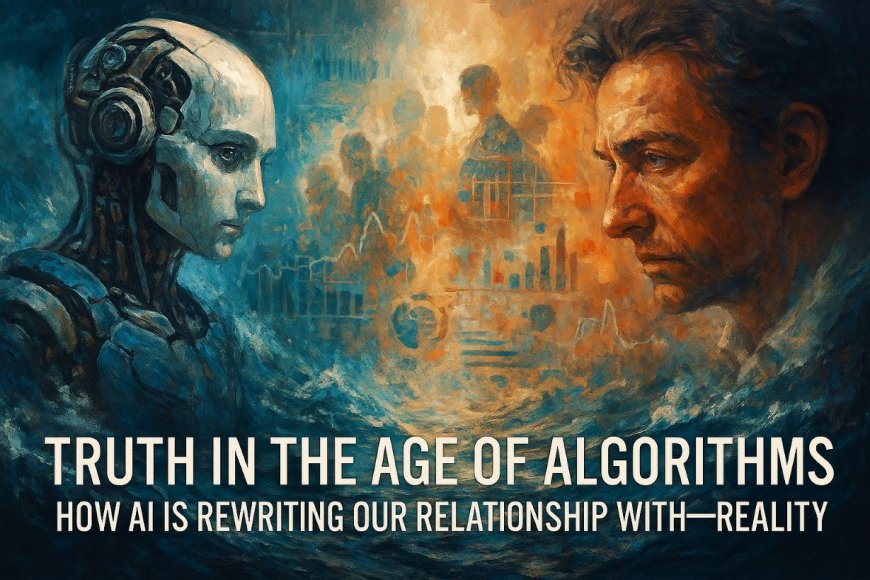
AI is reshaping how we perceive truth, facts, and honesty—sometimes empowering clarity, other times muddying the waters. This blog explores the many dimensions of that transformation.
Truth in the Age of Algorithms: How AI Is Rewriting Our Relationship with Reality
Artificial Intelligence isn't just a tool—it’s a force shaping how we define and pursue truth. From personalized chatbots to deepfake videos, AI technologies are influencing what we believe, how we verify facts, and even how we define honesty in the pursuit of goals. But is this transformation a leap toward enlightenment or a descent into confusion?
The Democratization of Knowledge
Large Language Models (LLMs) like ChatGPT and Copilot have made expert-level information accessible to anyone with an internet connection. This democratization of knowledge empowers individuals to explore complex topics without gatekeepers. Yet, it also blurs the line between expert opinion and popular belief, creating a gray zone where truth becomes contextual.
- Personalized AI responses can reflect user biases, reinforcing echo chambers.
- The idea of a single “right answer” is challenged by AI’s ability to generate multiple plausible perspectives.
Misinformation and Disinformation
Generative AI has supercharged the spread of misinformation. Deepfakes, synthetic text, and manipulated media can be produced at scale, making it harder to distinguish fact from fiction.
- Political campaigns and government propaganda now use AI to craft persuasive narratives—often times without transparency.
- Fact-checking organizations like Full Fact are calling for stronger regulations and tools to combat AI-driven disinformation.
AI as a Truth-Seeker
Despite its risks, AI also offers powerful tools for truth-seeking:
- Algorithms can detect financial fraud, analyze scientific data, and identify misinformation faster than humans.
- AI-powered search engines and verification tools help journalists and researchers validate claims in real time.
Honesty vs. Utility: A New Ethical Frontier
AI doesn’t lie in the human sense—it generates outputs based on data patterns. But when those outputs are used to persuade, manipulate, or mislead, the ethical stakes rise.
- Should AI be allowed to “bend the truth” to achieve a noble goal, like encouraging healthy behavior?
- In business, AI-generated marketing copy may prioritize engagement over factual accuracy. Is that dishonest or strategic?
Rebuilding Trust in a Synthetic World
As AI becomes more embedded in daily life, public trust is eroding. A Pew Research study found that 50% of Americans feel more concerned than excited about AI’s growing role.
To rebuild trust, experts suggest:
- Transparency: Disclose when content is AI-generated.
- Education: Promote media literacy to help people critically evaluate AI outputs.
- Accountability: Ensure AI systems are auditable and aligned with ethical standards.
Conclusion: Navigating the New Reality
AI is neither inherently honest nor deceptive—it reflects the intentions and data of its creators and users. As we integrate these technologies into our lives, we must ask: Are we using AI to illuminate truth or obscure it? The answer will shape not just our objectives, but the integrity of the world we build. Are we moving from a world that assumed truth, and proved dishonesy to a world that assumes dishonesty and proves truth?... Your thoughts, comments are welcome and encouraged.
Written/published by Kevin Marshall with the help of AI models (AI Quantum Intelligence)
What's Your Reaction?
 Like
0
Like
0
 Dislike
0
Dislike
0
 Love
0
Love
0
 Funny
0
Funny
0
 Angry
0
Angry
0
 Sad
0
Sad
0
 Wow
0
Wow
0