














The Great Indian Pivot: How Agentic AI is Redefining the "World’s Back Office"
In this article, we explore India’s strategic pivot from labor arbitrage to Agentic AI Orchestration. Discover how sovereign infrastructure and autonomous AI agents from firms like TCS are redefining global IT solutions for 2026 and beyond.
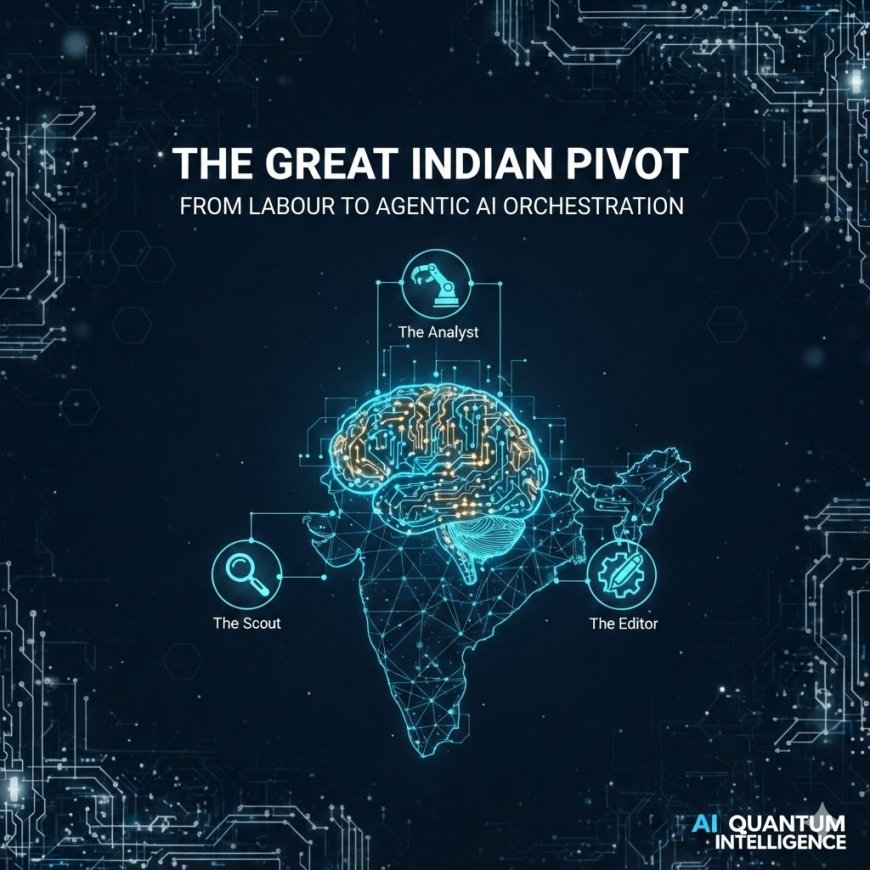
India’s tech behemoths are facing an existential threat from Generative AI. Their response? A massive strategic shift from labour arbitrage to "Agentic Orchestration," transforming how global IT services are delivered.
For three decades, the narrative of India’s technological rise was straightforward: high-quality engineering talent delivered at a cost structure the West couldn't match. This "labour arbitrage" model built empires, turning cities like Bangalore and Hyderabad into global hubs for Business Process Outsourcing (BPO) and IT services.
However, the arrival of Generative AI creates an immediate existential crisis. If an LLM can write basic code, summarize contracts, or handle L1 customer support instantly and essentially for free, the traditional Indian IT services model faces a significant challenge.
That said, as we move further into 2026, a new narrative is emerging. India is not being replaced by AI; it is aggressively re-platforming onto it. The country’s strategy has shifted from supplying human labour to supplying Intelligent Orchestration. The central technology driving this pivot is Agentic AI.
Beyond the Chatbot: Understanding the "Agentic Shift"
To understand India’s new strategy, one must distinguish between standard Generative AI and Agentic AI.
A standard LLM (like ChatGPT) is passive; you prompt it, and it gives an answer. It is a knowledge retrieval engine.
An AI Agent, however, is active. It is an LLM equipped with "tools"—the ability to call APIs, browse the web, access internal databases, and execute code. An agent doesn't just tell you how to fix a server outage; it logs in, diagnoses the logs, restarts the service, validates the fix, and updates the “Jira” or IT service management ticket without human intervention.
For Indian IT giants, this is the holy grail. It allows them to move up the value chain, transitioning from billing for "hours worked" to billing for "outcomes achieved."
The Enablers: Infrastructure and Talent at Scale
This shift isn't happening in a vacuum. It is supported by a concerted national effort to build sovereign AI capabilities, ensuring India isn't entirely dependent on Western hyperscalers.
- The Compute Backbone: The IndiaAI Mission, with its substantial budget allocation through 2026, has successfully democratized access to compute. By subsidizing thousands of GPUs, startups and major enterprises alike can train and deploy agentic models domestically, reducing latency and data sovereignty concerns.
- The Talent Factory Pivot: India’s massive engineering workforce is undergoing rapid re-skilling. The focus has shifted from traditional coding to "Context Engineering" and "AgentOps"—the specialized skills required to build, monitor, and govern fleets of autonomous AI agents.
Case Study: TCS and the "WisdomNext" Orchestration
To visualize this in practice, we look at Tata Consultancy Services (TCS), a bellwether for the industry. TCS recognized early that simply adding AI "copilots" to aid human workers was insufficient to protect their market share. They needed to redefine the delivery service itself.
The Platform: TCS AI WisdomNext - TCS launched AI WisdomNext as an aggregated platform designed not just to host models, but to orchestrate complex business workflows using multiple AI agents working in concert.
The Agentic Workflow in Action: Cloud Infrastructure Management A very large European banking client relies on TCS to manage its hybrid cloud infrastructure. Traditionally, this required hundreds of TCS engineers monitoring dashboards across three shifts to handle routine alerts (disk space issues, service deviations, security patch updates).
Through WisdomNext, TCS deployed an Autonomous Infrastructure Squad:
- The Sentinel Agent (Monitoring): Ingests real-time logs from the client's AWS and Azure environments. It doesn't just flag anomalies; it uses historical data to predict failures before they happen.
- The Diagnostician Agent (Analysis): When an alert is triggered, this agent accesses a vector database filled with decades of TCS troubleshooting runbooks. It correlates the current error with past successful resolutions.
- The Executor Agent (Action): Crucially, this agent has secure, scoped access to the client's environment via APIs. If the Diagnostician recommends a specific server restart sequence and a cache clearance, the Executor Agent performs these actions autonomously.
- The Compliance Agent (Governance): Every action taken by the Executor is logged, checked against regulatory requirements (like GDPR for the banking client), and documented for audit trails.
The Outcome: By deploying these agentic squads, TCS didn't just reduce headcount on the account. They fundamentally changed the engagement model. They moved the client from a Service Level Agreement (SLA) based on "response time" to a Business Level Agreement (BLA) based on "system uptime and reliability."
TCS delivered a higher quality service at a lower cost to the client, while simultaneously increasing their own margins by decoupling revenue from human labour hours.
Commentary: The Outlook for 2026 and Beyond
The successful deployment of agentic workflows by giants like TCS, Infosys (via their Topaz offering), and HCLTech signals a maturing Indian AI ecosystem. Looking ahead through 2026 and beyond, three key trends will define India's trajectory:
1. The "SaaSpocalypse" Defense (Short-Term 2026): Indian IT is currently in a race to cannibalize its own revenue before competitors do. The realization is stark: BPO services that involve staring at a screen and clicking buttons will hit zero value. Indian firms are aggressively using agentic AI to turn services into products. Instead of hiring 50 people for accounts payable, they are selling an "Autonomous Finance Agent" as a managed service. This outcome-based pricing model is the only bridge to the future.
2. Sovereign AI as a Geopolitical Asset (Medium-Term): India appears wary of building its future entirely on American AI foundations (OpenAI, Google, Anthropic). Initiatives like the Bhashini platform (indigenous language AI) and the push for domestic silicon represent a drive for "AI Autonomy." By 2027, expect to see Indian IT firms offering "sovereign stacks" to European and Asian clients terrified of US data hegemony—offering solutions where data never leaves national borders and is processed by non-US models.
3. Champion of the "Global South" (Long-Term): Perhaps the most significant strategic play is India positioning itself as the leader of AI for the developing world. Western AI is often expensive and resource-intensive. India is pioneering "frugal AI"—highly efficient, smaller models designed to run on constrained infrastructure. By exporting these affordable, scalable agentic solutions to Africa, Southeast Asia, and Latin America, India aims to build a new sphere of technological influence, distinct from both the US and China.
Conclusion: The shift to Agentic AI is not merely a technical upgrade for India; it is an economic imperative. By successfully transitioning from a supplier of talent to an orchestrator of autonomous systems, India is ensuring it remains the indispensable engine room of the global digital economy for the next decade.
Written/published by Kevin Marshall with the help of AI models (AI Quantum Intelligence).
What's Your Reaction?
 Like
0
Like
0
 Dislike
0
Dislike
0
 Love
0
Love
0
 Funny
0
Funny
0
 Angry
1
Angry
1
 Sad
0
Sad
0
 Wow
0
Wow
0